
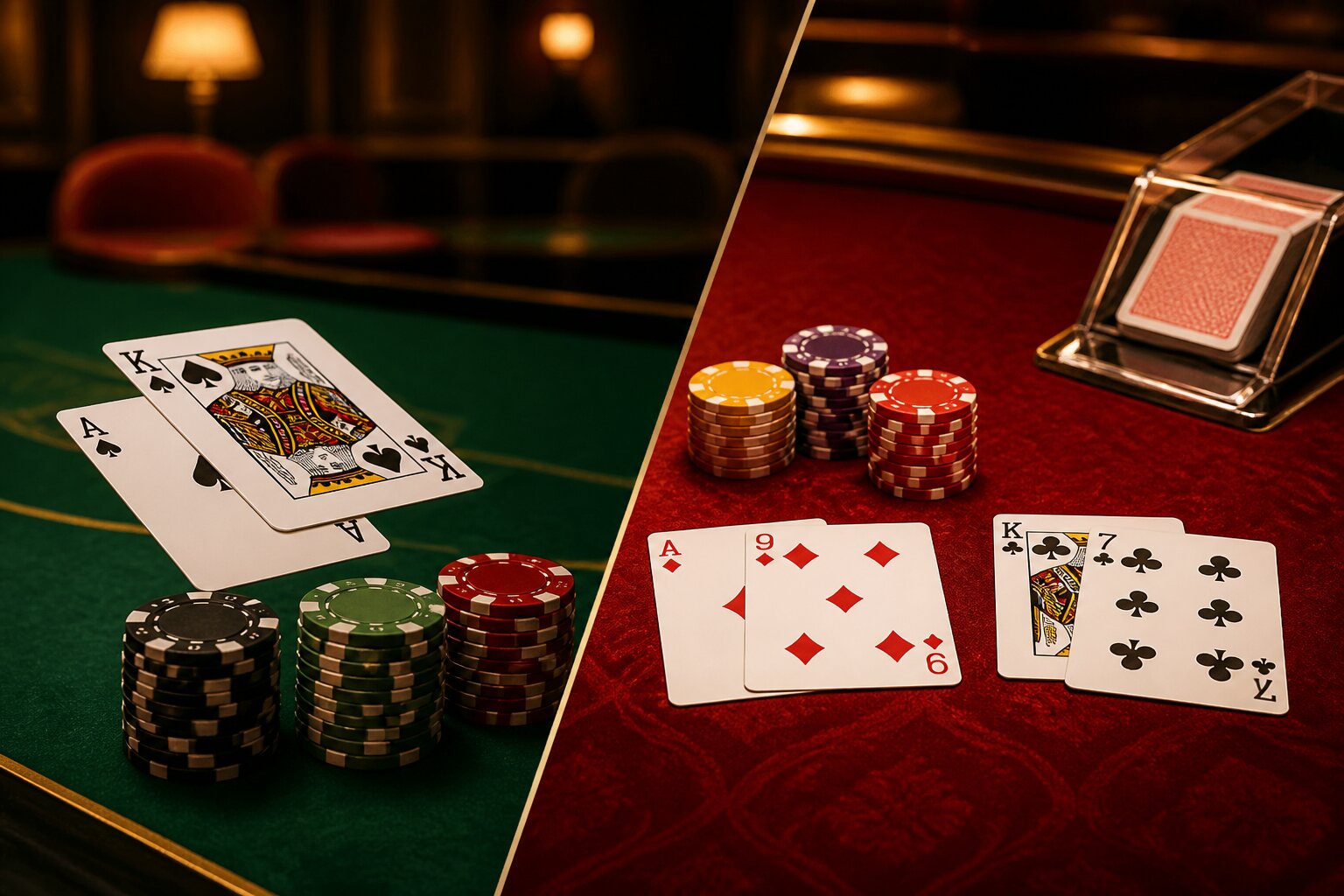
Ever wondered which card game deserves your time and money: baccarat or blackjack? With so many options at the online casino, it’s easy to feel a bit lost when both games offer table play and the chance of winning.
Whether you’re a seasoned player or just starting out, understanding the real differences between baccarat and blackjack can help you choose a game that suits your style and your wallet. From how each game works to the typical payouts, a closer look will give you the confidence to pick one—or try both.
Read on to learn the key contrasts and what to expect from each game.
Key Differences Between Baccarat And Blackjack
Baccarat and blackjack may look similar at first glance, but they each have distinct structures and player roles. The biggest divide is how much control you have. In blackjack, your choices matter: you decide whether to hit, stand, split or double down, and those decisions influence the outcome of your hand. Baccarat is more automatic. After placing a bet, the dealing follows set drawing rules and players do not make further decisions during the round.
Card values and objectives also differ. Blackjack aims for a total closest to 21, with picture cards worth ten and aces counting as one or eleven. Baccarat seeks a total closest to nine, with tens and face cards counting as zero and only the final digit of the total considered. Strategy therefore plays a heavier role in blackjack, while baccarat’s appeal lies in its simplicity and steady rhythm.
These contrasts shape how each game feels at the table and set the scene for a closer look at how the rules actually work.
Baccarat And Blackjack Rules Explained
In baccarat, play begins with bets placed on the player hand, the banker hand, or a tie. Two hands are dealt, each receiving two cards. Totals of eight or nine are naturals and end the round. Otherwise, a third card may be drawn according to predetermined rules for the player and the banker. Only the final digit of a hand’s total counts — for example, a total of 14 becomes 4. The higher total wins.
Blackjack starts with two cards to each player and the dealer. The objective is to reach a total as close to 21 as possible without exceeding it. Numbered cards count at face value, picture cards are worth ten and aces can be one or eleven depending on which best serves the hand. Players take turns making decisions about whether to take additional cards or keep their hand, and if a hand exceeds 21 it busts. After players finish, the dealer follows set rules—typically hitting until reaching 17 or more.
These rule sets determine how much decision-making there is for a player, which in turn affects betting choices and strategy.
How Do The Betting Options Vary?
Baccarat’s betting is intentionally simple: bets are placed on the player, the banker, or a tie before the deal. Optional side bets are offered in some versions, for example on pairs or specific card combinations, but they are not required to play and usually carry higher house edges.
Blackjack provides more in-play options. The initial stake covers your main hand, but depending on the cards you receive you may be able to split a pair, double your stake for one additional card, or place side bets such as insurance against the dealer having blackjack. These choices alter the shape of a round and can increase both potential returns and volatility.
Understanding the available bets in each game helps set expectations for risk and involvement during play, and leads naturally into how the house edge compares between the two games.
House Edge: Which Game Offers Better Odds?
The house edge represents the casino’s mathematical advantage, expressed as a percentage of each bet over the long run. It shows how much, on average, the operator expects to keep from each stake after many plays. A lower house edge generally means better value for the player, though it does not change the randomness or outcome of any single round.
Knowing typical edges can help guide game selection and inform stake sizing, but it is important to remember that these figures describe long-term averages rather than short-term guarantees. Players should also be aware of the risks and play within their means.
House Edge In Baccarat
Baccarat’s edge depends on the bet you choose. The banker bet is usually the most favourable option, with a house edge around 1.06% after the standard commission is applied. The player bet carries a slightly higher house edge, typically about 1.24%, which still compares well with many other casino games.
Tie bets are a very different proposition. They carry a much larger house edge, often over 14%, which makes them substantially less favourable over time and not recommended for those seeking better expected value. Those percentages assume typical table rules and normal play; variations in rules can alter the exact figures.
House Edge In Blackjack
Blackjack’s house edge can vary considerably because it depends on the specific table rules and on the decisions made by the player. With commonly used rules and when a player follows basic strategy, the edge can be as low as about 0.5%, making blackjack one of the more favourable casino games for informed players.
Less favourable rule sets or suboptimal choices increase that percentage, sometimes by a large margin. Because rule variations matter, checking the specifics of a table and understanding basic strategy will give a clearer picture of expected value and help manage risk.
With those odds in mind, the next question is what payouts you can expect when you win.
Payouts: What Can Players Expect?
Payouts show the return you receive when a bet wins. They depend on the bet type and the game rules, and they influence how attractive different wagers are over time. Understanding typical payouts helps you see how much of a game’s return is determined by luck and how much is taken by the house.
Standard Payouts In Baccarat
Winning bets on the player hand pay 1:1, returning your stake plus an equivalent amount. Banker wins also pay 1:1, though a commission—commonly 5%—is taken on winning banker bets, which slightly reduces the net return. That commission is why the banker bet usually has the lowest house edge, even after the fee is applied.
Tie bets offer much higher nominal payouts, typically 8:1 or 9:1, but their low probability makes them poor value relative to the risk. Because ties occur so rarely, the large payout does not compensate for the long-run expected loss, so tie bets increase volatility without improving expected returns.
House rules and commission rates can vary between venues and online providers, so checking the exact payouts and fees before wagering is important. Small differences in payout structure can translate into meaningful changes in the long-term return to player.
Standard Payouts In Blackjack
If a player’s first two cards form blackjack, the usual payout is 3:2, so a £10 stake returns £25 including the stake. Some venues use altered payouts such as 6:5 for blackjack, which reduces the player’s expected return, so it is wise to confirm the table rules. Regular wins against the dealer pay even money, 1:1.
Insurance, when offered, typically pays 2:1 if it succeeds, but it is a separate side wager with its own expected value and is generally regarded as unfavourable for most players. The precise house edge in blackjack depends on the rules in play, such as whether the dealer hits on a soft 17, how many decks are used, and whether doubling and splitting options are restricted.
Payouts can vary by table and operator, so reviewing rules before playing clarifies what to expect. Knowing the likely returns and the house edge helps you make informed choices and keeps play responsible and within your limits.
Having covered the financial side, it helps to consider which game is more approachable for newcomers.
Which Game Is Easier For Beginners?
Baccarat is generally seen as more straightforward for beginners because choices are limited to the initial bet. Once the bet is placed, the round proceeds automatically, which makes the game easy to learn and quick to pick up. That simplicity can be especially attractive for new players who prefer to focus on the social side of play rather than on tactical decisions.
Blackjack requires a familiarity with options and some decision-making under pressure. Understanding when to hit, stand, split or double down improves outcomes and adds involvement to each hand. While this extra layer can feel daunting at first, it also gives players the chance to influence results through informed play.
Both games suit different temperaments: one offers simplicity, the other strategic engagement. Next, consider how those differences shape the table atmosphere.
Player Experience: Table Atmosphere & Engagement
The feel at baccarat and blackjack tables often reflects their rules and pace. Baccarat typically moves at a steady rhythm with limited player input once bets are placed, creating a measured and composed environment. This controlled pace suits players who prefer a cleaner, less intervention-heavy experience.
Blackjack tables usually have a livelier feel because players act on each hand and interact more with the dealer and fellow players. That engagement can create a more social and reactive atmosphere where choices and reactions form part of the excitement.
Whichever table you prefer, choosing a setting that matches your comfort with decision-making helps make the experience more enjoyable, and the next section clears up some common misunderstandings that affect expectations.
Common Misconceptions About Baccarat And Blackjack
A number of myths persist around both games, and addressing them helps set realistic expectations. One is the belief that skilful play guarantees consistent winnings. While strategy in blackjack can reduce the house edge, outcomes remain subject to randomness and no approach ensures steady profit.
Another misconception concerns the effectiveness of card counting or similar techniques, particularly online. Many digital or live-dealt games use frequent reshuffles or randomisation that make counting unreliable in most settings.
There’s also a mistaken idea that past patterns or table position influence future outcomes; dealing remains random within the rules. Treating the games as entertainment rather than a source of income, understanding the rules and typical payouts, and choosing bets that match one’s risk tolerance supports a better playing experience.
Both games have clear appeals: baccarat for simplicity and steady play, blackjack for strategic depth and choice. By comparing rules, bets, house edge and table atmosphere you can decide which suits your preferences and play responsibly within your limits for an enjoyable session.
**The information provided in this blog is intended for educational purposes and should not be construed as betting advice or a guarantee of success. Always gamble responsibly.