
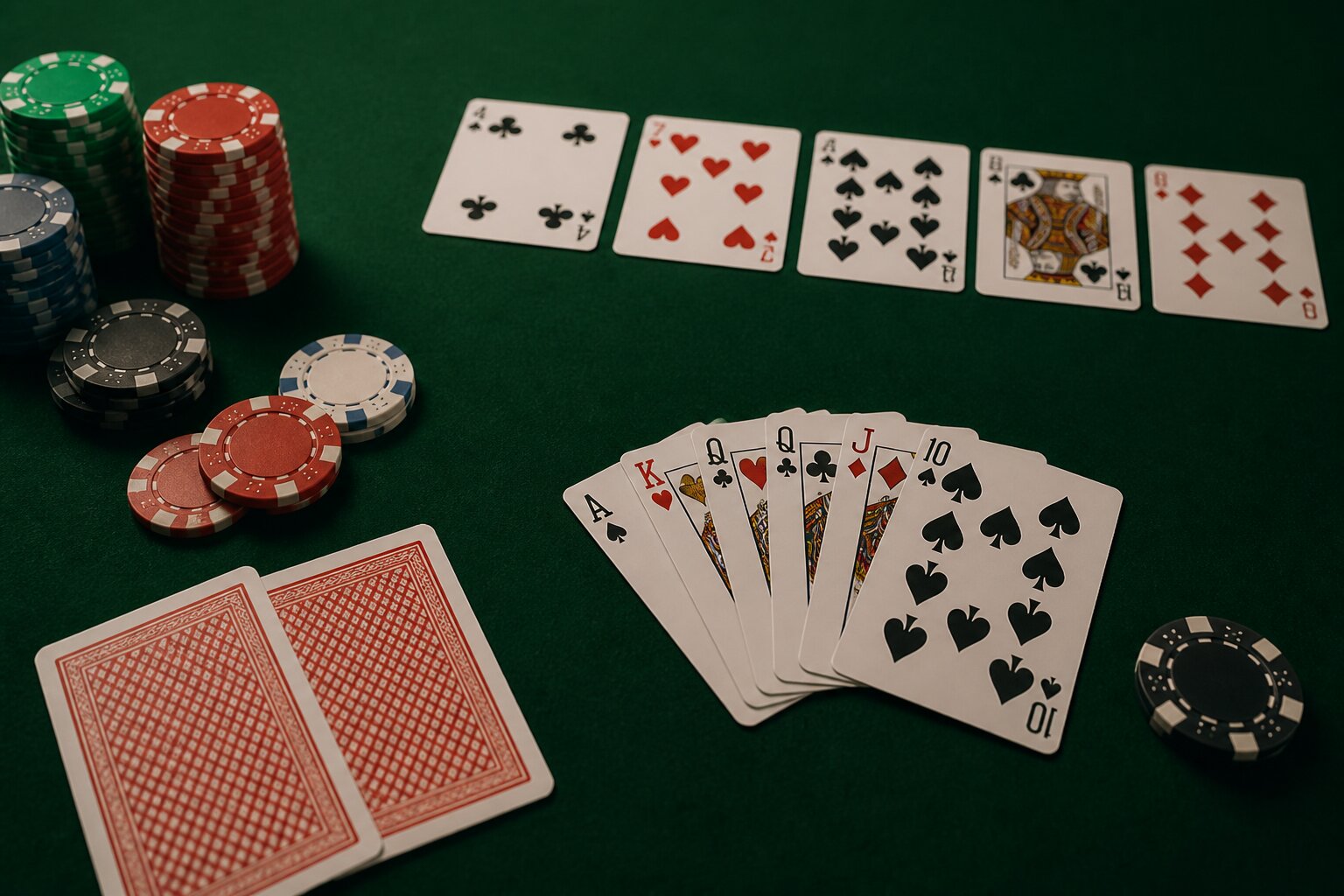
Struggling to keep up at the poker table? You’re not alone. All the hand rankings, betting rounds and etiquette can feel like a lot at first, but a few clear rules and reminders will make the game much easier to follow.
This cheat sheet brings the essentials together: the hand rankings you must know, the charts that guide early decisions, and the core rules that keep play fair. Read through at your own pace and use this as a quick reference whenever you need it.
Ready to sharpen your understanding and play with more confidence? Let’s get started.
What Are the Most Important Poker Hands?
A clear grasp of the standard hands is the foundation of good poker play. Below are the hands ranked from strongest to weakest, with brief examples to show how they look in practice.
Before the list, remember that suits have equal value: a heart and a spade of the same rank are equivalent.
Royal Flush: Ace, King, Queen, Jack and 10, all in the same suit — the highest possible hand.
Straight Flush: Five sequential cards in the same suit, such as 6-7-8-9-10 of hearts.
Four of a Kind: Four cards of the same rank, for example four Jacks; the fifth card is the kicker.
Full House: Three of one rank plus a pair of another, such as three 8s and two Kings.
Flush: Any five cards of the same suit that are not in sequence.
Straight: Five cards in consecutive rank order, with mixed suits permitted.
Three of a Kind: Three cards of the same rank plus two unrelated cards.
Two Pair: Two distinct pairs, for example two 9s and two 4s, plus a kicker.
One Pair: A single pair with three side cards.
High Card: When no player has any of the above, the single highest card determines the winner.
Keep this ordering in mind during play — knowing which hands beat which is the quickest way to make sound choices at the table.
Understanding Poker Hand Rankings
Hand rankings are consistent across most popular poker variants, so the order above applies whether you’re looking at Texas Hold’em, Omaha or another community-card game.
When comparing hands of the same type, the ranks of the constituent cards decide the winner. For example, a pair of Queens outranks a pair of 10s. If players hold identical pairs, the highest remaining side card, or kicker, breaks the tie. In more complex ties—such as two players holding straights of the same top card—further card values are checked until a difference appears or the pot is split.
These rules mean that beyond knowing the hierarchy, reading the likely strength of opponents’ hands from the betting and community cards becomes essential. That skill helps you judge when to stay in, when to fold, and when it may be worth contesting the pot.
A grasp of rankings also reduces disputes at the table: when everyone understands how hands compare, gameplay stays smooth and fair.
Which Charts Should Every Poker Player Know?
Charts condense common strategic decisions into quick-reference formats so you can make faster, clearer choices during a hand. They’re especially useful when you’re learning standard approaches to different positions and starting cards.
Two chart types prove most helpful for a wide range of players: starting hand charts and position charts. Both work together to give a practical overview of what to play and when to be cautious.
Starting Hand Charts Explained
A starting hand chart ranks two-card combinations in Hold’em by their general playability. Premium pairs such as A-A or K-K, and strong suited broadways like A-K suited, are near the top because they perform well across many flop scenarios. At the other end are disconnected, unsuited low cards such as 7-2, which rarely improve to competitive hands and are typically folded.
Using a starting hand chart doesn’t eliminate judgement: table dynamics, stack sizes and opponent tendencies can justify deviations. But for newcomers, the chart is a reliable baseline to avoid costly mistakes and to build consistent hand selection.
Position Charts: Why Do They Matter?
Position charts show how your seat relative to the dealer affects the range of hands you should play. Acting early in a betting round means making choices with less information, so the recommended range narrows to stronger hands. Acting late lets you see others’ actions first, so you can widen your range and make more nuanced decisions.
For instance, an off-suit intermediate hand might be playable in late position when fewer players remain to act, but it’s often folded from early position. Understanding position helps you make better calls on whether a given starting hand is worth pursuing in that moment.
When you combine starting-hand guidance with position awareness, your preflop decisions will align more closely with sound risk management and practical table sense.
Fundamental Poker Rules You Must Know
Knowing the standard flow of play keeps a table orderly and ensures everyone has a fair shot at the pot. Most community-card poker games follow the same basic structure and terminology.
A typical hand begins with forced contributions to the pot (blinds or antes) so there’s something to play for. Players are dealt their private cards—two in Hold’em, four in Omaha—then a sequence of betting rounds starts. Between those rounds, community cards are revealed and become part of everyone’s potential hand.
On each betting turn, a player chooses from folding, matching the current bet, or increasing it; these choices change the pot size and the information available to others. If all but one player folds, the remaining player wins without a showdown. If multiple players reach the final betting round, they reveal their hands and the best one, according to the established rankings, takes the pot.
Understanding these mechanics makes observing opponents and assessing pot odds easier, helping you make clearer, more consistent decisions as the hand develops.
What Are the Biggest Myths About Poker Rules?
Several persistent misunderstandings give new players the wrong ideas about how to play. Clearing these up helps you focus on practical skills rather than myth.
One mistaken belief is that certain systems or betting patterns guarantee success. There is no formula that removes uncertainty in poker; instead, players manage risk by making decisions based on probabilities, position and opponent behaviour. Another myth is that you must play every hand to stay competitive; on the contrary, folding is a core strategic tool when the odds aren’t favourable.
People also sometimes attach undue significance to where they sit or to isolated early wins; those do not determine long-term outcomes. Finally, while bluffing is a recognised tactic, effective play relies equally on timing, observation and disciplined hand selection.
Recognising these myths helps you avoid habits that look clever but undermine consistent results. Clear thinking and measured decision-making matter most at the table.
How Can a Poker Cheat Sheet Improve Your Game?
A compact cheat sheet brings essential information into one place so you can refresh your memory without stopping the action. It typically includes the hand rankings, a basic starting-hand guide and reminders about how position affects play.
Using a cheat sheet supports better decisions by reducing common errors—misreading a hand, misjudging relative strength, or forgetting which hands outrank others. It’s particularly useful when you’re learning or when you move between variants that share similar principles but differ in detail.
Think of the sheet as a reference rather than a rulebook: it smooths out uncertainty and helps you play with more consistency. Keep track of your limits and consider site tools that control session length or spend if you ever want extra safeguards. A well-used cheat sheet helps make the game clearer and more enjoyable.
Play with confidence, stay observant, and use this guide whenever you need a quick reminder.
**The information provided in this blog is intended for educational purposes and should not be construed as betting advice or a guarantee of success. Always gamble responsibly.