
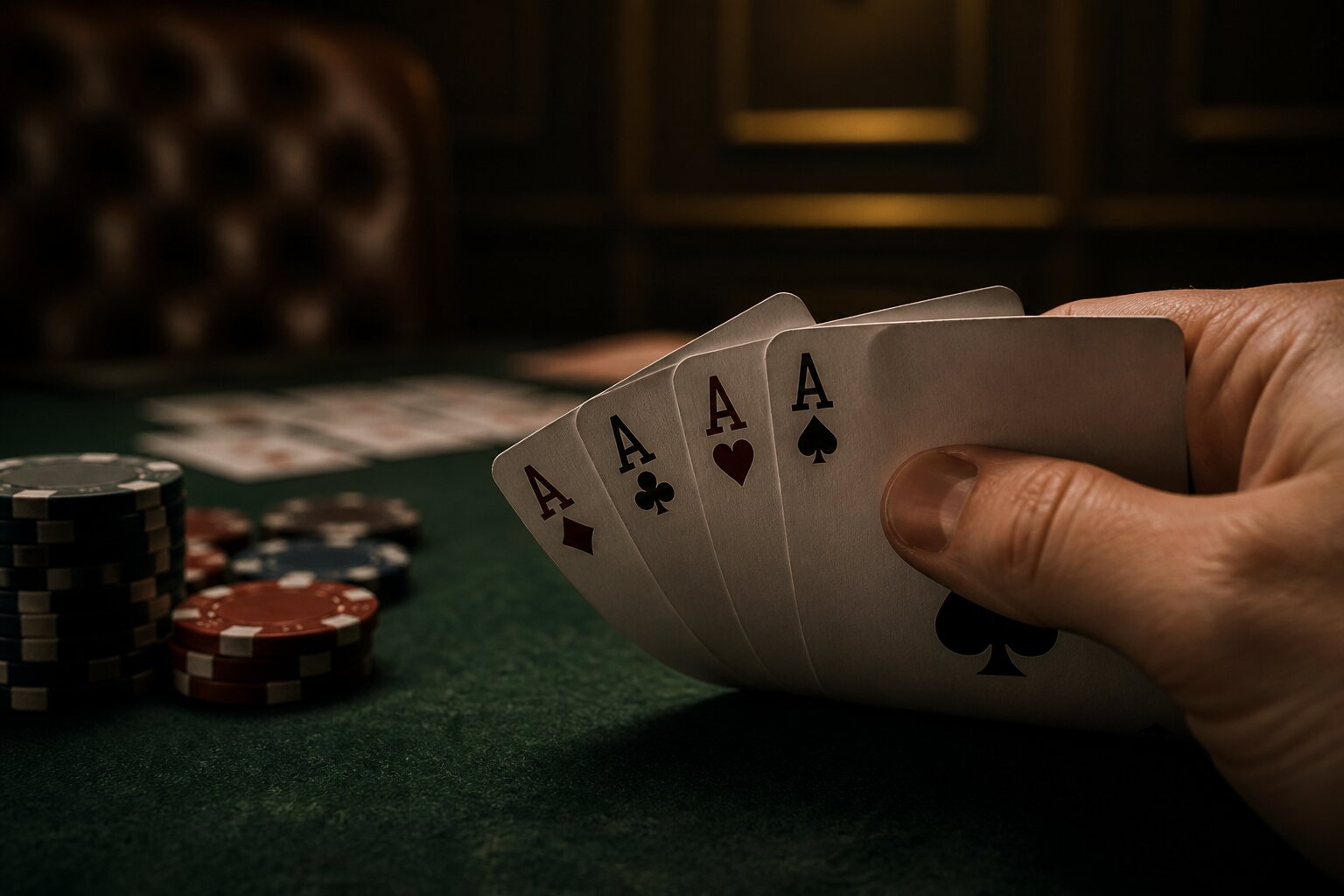
Poker has its fair share of fascinating stories, but few are as mysterious or legendary as the “Dead Man’s Hand.” This famous hand isn’t just a quirky name—it’s wrapped in tales of the Wild West, fateful showdowns, and historical intrigue.
Have you ever wondered why two specific pairs in poker are connected to a chilling legend? Or why some players still view these cards with a mix of awe and superstition? The origins of the Dead Man’s Hand are as gripping as any movie scene.
If you want to know which cards form the hand, how the name arose, and why it endures in poker culture, read on — the tale moves from the table to history and back again.
What Is the Dead Man's Hand in Poker?
The Dead Man’s Hand refers to a particular two-pair combination: aces and eights, traditionally both black suits. The most commonly cited composition is the ace of spades, ace of clubs, eight of spades, and eight of clubs, plus a fifth unknown card. In games where five cards are held, that final card completes the five-card hand; in community-card games like Texas Hold’em, the pattern is the same but formed from hole cards and the board.
In standard poker hand-rankings this is simply a two-pair hand and has no special status or rules attached. Its significance is cultural and historical rather than strategic: it doesn’t win or lose by virtue of the name. In practical terms, whether it beats another hand depends on the usual factors — the game variant, the community cards, and the opponents’ holdings.
This context helps explain why the Dead Man’s Hand is more a piece of storytelling than a tool for play. With that in mind, it’s worth exploring how the name became attached to these specific cards, which takes us into the history of the American frontier.
Why Is It Called the Dead Man's Hand?
The name “Dead Man’s Hand” grew from a well-known episode in frontier history involving James “Wild Bill” Hickok. In August 1876, Hickok was shot while seated at a poker table in Deadwood, South Dakota. Contemporary and later accounts record that he was holding two black aces and two black eights at the time of his death, and the dramatic nature of the event linked those cards with his fate.
Newspapers, storytellers and later writers repeated the detail, and the phrase “Dead Man’s Hand” gradually attached itself to that particular combination. Historical records from the moment are sparse and sometimes inconsistent, so the exact contents of Hickok’s hand were never firmly documented at the time; the black aces and eights version crystallised later as the accepted form of the legend.
That mixture of a vivid incident and uncertain record is what made the name stick: a striking image with just enough mystery to keep people talking. Next, the development of the tale and how it entered broader culture shows how legend and reporting combined to shape the hand’s identity.
Unravelling the Origins of the Dead Man's Hand
The story of the Dead Man’s Hand is a blend of history, memory and later embellishment. Over time, retellings in print and on screen smoothed out differences between sources and pushed the black aces and eights detail to the forefront.
The Connection to Wild West Lore
Hickok’s notoriety as a gunslinger, lawman and gambler made any detail of his end especially resonant. The image of a famous figure felled at a poker table struck a strong chord, and the specific cards became a memorable symbol tied to that scene. As accounts of frontier life spread through newspapers, dime novels and later films, the hand became shorthand for the dangers and dramas associated with the era.
That cultural momentum is why you see the Dead Man’s Hand used in Western fiction and iconography: it provides an immediate, recognisable visual linked to a dramatic story.
Early References and Historical Evidence
References to the phrase appear intermittently in late 19th and early 20th century sources, but the precise card combination varies in those accounts. It was not until the early 20th century that the black aces and eights narrative became the dominant version. Researchers note that much of the tale relies on second-hand accounts written years after Hickok’s death, which explains the inconsistencies.
The lack of an official, contemporaneous inventory or photograph means historians depend on newspapers, memoirs and the gradual shaping of the story over decades. This patchwork of evidence is a good illustration of how popular memory can harden into accepted fact even where primary documentation is thin. That evolution helps explain why the Dead Man’s Hand is now a fixture of poker lore rather than a strictly provable historical fact.
The Legend of Wild Bill Hickok
Wild Bill Hickok’s life and death supply the human drama behind the hand; understanding a little about him clarifies why the incident resonated so strongly with contemporaries and later audiences.
Who Was Wild Bill Hickok?
Born James Butler Hickok, he became a public figure on the frontier through roles as a scout, lawman and professional gambler. Stories of his marksmanship and confrontations made him a larger-than-life character; journalists and popular writers amplified his exploits, sometimes blurring fact and fiction. His celebrity meant that events involving him, including his death, attracted wider attention than an ordinary gambler’s demise ever would.
That heightened profile ensured the details of his final moments would be repeated, debated and embellished, helping to carry the Dead Man’s Hand into cultural memory.
The Circumstances Surrounding His Last Poker Game
In Deadwood, Hickok was playing in a makeshift saloon when Jack McCall shot him from behind. Contemporary reports differ on motive and exact sequence, but McCall later claimed grievance and was executed for the murder. The claim that Hickok held black aces and eights emerged in accounts published after the event, and the dramatic tableau of a famous man struck down mid-game made the image stick.
This scene—famous gambler, famous death, a hand left unfinished—was the kind of episode that lent itself to retelling. Its ongoing resonance comes less from documentary certainty and more from the way it captured the public imagination, which leads naturally into how the hand has been treated in culture since.
How Has the Dead Man's Hand Influenced Poker Culture?
The Dead Man’s Hand has travelled far from that saloon table and into films, books, merchandise and the broader language of poker. Its presence today is mostly symbolic, used to evoke a mood or a theme rather than to suggest anything about play.
Portrayal in Films, TV, and Literature
Writers and filmmakers who want to hint at danger or a turning point often use the Dead Man’s Hand as a visual or narrative motif. Westerns in particular have adopted it as a shorthand, and crime or historical dramas sometimes reference it to signal a fateful moment. Novels on gambling or frontier history revisit the tale, and dramatists take advantage of the hand’s built-in associations to colour scenes without lengthy explanation.
This recurring use in storytelling has reinforced the hand’s place in the public imagination and helped preserve Hickok’s last game as a touchstone of Western myth-making.
Use in Modern Poker and Popular Culture
Beyond entertainment, the Dead Man’s Hand appears in poker imagery—in posters, themed decks and event names—and is occasionally invoked by commentators to add colour to a broadcast. In gameplay itself, its relevance is purely anecdotal: players may enjoy identifying the combination, but it has no bearing on strategy or outcomes. The hand’s endurance in popular culture reflects the human appetite for stories that connect small details — like a set of cards — to larger drama.
With the cultural side covered, it’s worth addressing some of the misunderstandings that have grown up around the hand.
Common Misconceptions About the Dead Man's Hand
Several myths have attached themselves to the Dead Man’s Hand over the years. One is the idea that the hand carries a curse or supernatural influence; another is that it is always unlucky or inherently weak. Neither claim has any basis in gameplay: two aces and two eights is simply a two-pair hand whose strength depends on the context of the deal and the variant being played.
Another misconception is certainty about the hand’s exact historical makeup. As already noted, early reports varied and the black-aces-and-eights version became standard only later; that ambiguity is part of the reason the hand invites myth-making. Understanding these points helps separate the evocative story from practical reality and keeps the legend where it belongs—on the cultural, rather than competitive, side of poker.
Having cleared up those misunderstandings, it’s natural to ask whether the legend still colours people’s attitudes at the table today.
Does the Dead Man's Hand Hold Any Superstition Today?
The Dead Man’s Hand can still prompt a shiver of interest among players and fans because of its story, and it often shows up as a thematic or theatrical element in events and broadcasts. In the routine of modern play, however, it has no deterministic power. Success at poker comes from understanding the rules, reading situations, and making sound choices given the information at hand.
For most people the hand functions as a historical footnote or a colourful line in commentary rather than a portent. That perspective keeps the story enjoyable without elevating it into a factor that should guide decisions at the table.
Conclusion: The Lasting Legacy of the Dead Man's Hand
The Dead Man’s Hand endures because it combines a memorable image with an unresolved historical moment—an apparent two-pair left on a table after a famous man’s murder. It lives in our films, books and poker talk as a reminder of how a single scene can echo through time.
Approached as part of poker’s rich cultural tapestry, the hand adds flavour to the game without altering how it is played. Treat the legend as a story worth knowing, and keep play measured and informed so the pastime stays enjoyable and sustainable.
**The information provided in this blog is intended for educational purposes and should not be construed as betting advice or a guarantee of success. Always gamble responsibly.