
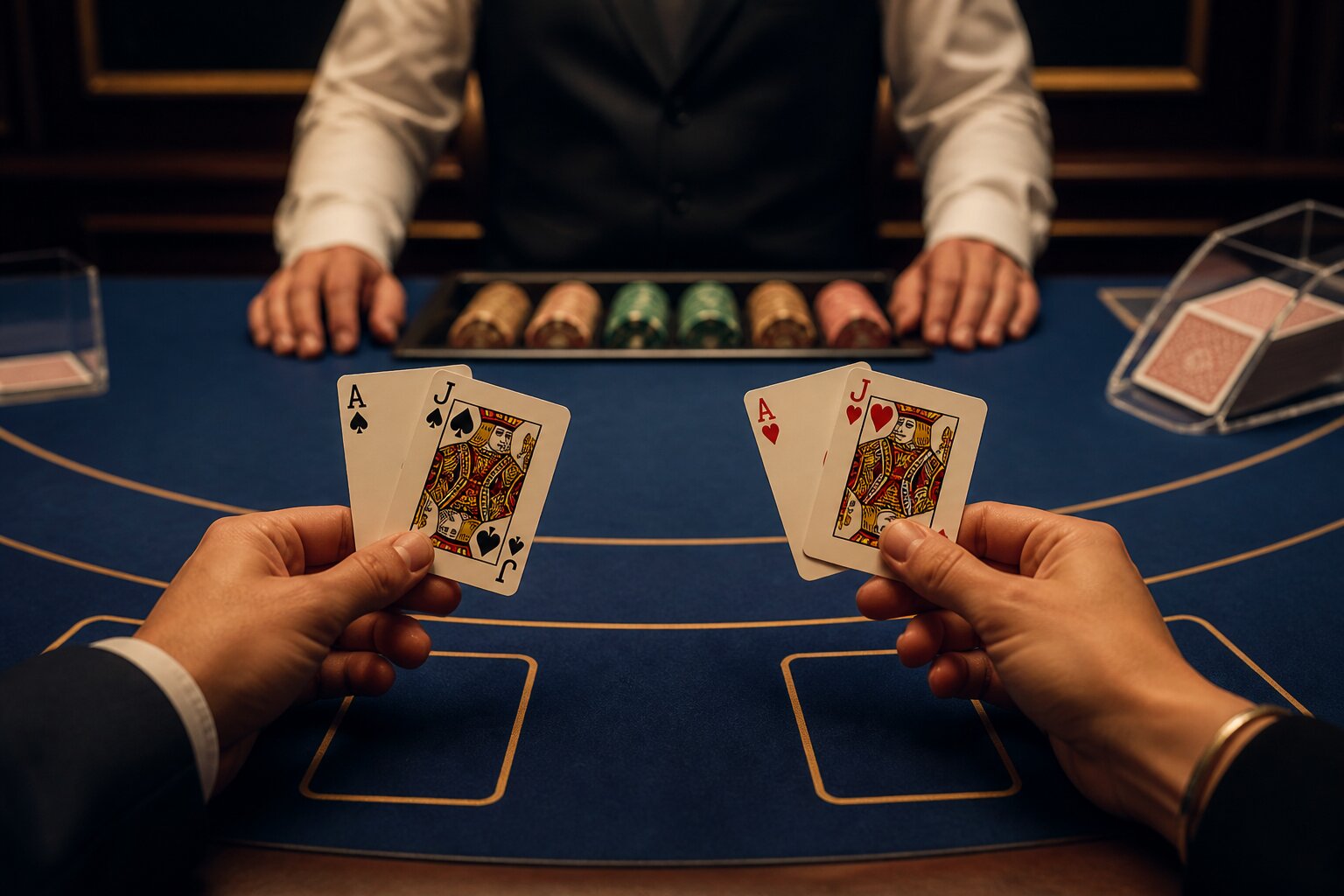
Blackjack is a fast game that mixes decision-making with the tension of watching cards be revealed. When two players both reach 21, it can feel like a puzzle — who wins, who pushes, and what exactly matters?
This article explains how those situations are resolved, the difference between a natural blackjack and a 21 made with more cards, and how payouts are settled so you know what to expect at the table. Read on to learn the rules that determine the outcome when multiple hands reach 21.
How Is a Tie Handled in Blackjack?
When two players each have 21, they are not competing against one another; each hand is resolved separately against the dealer’s final total. If the dealer’s hand is lower than 21, any player with 21 wins and receives the payout that applies to their type of 21. If the dealer also has 21, the result depends on whether the 21s were natural blackjacks or made with additional cards.
A push happens when neither the player nor the dealer wins — the player’s original stake is returned. If the dealer’s two-card hand is an Ace plus a 10-value card (a natural blackjack) and a player’s 21 required three or more cards, the dealer’s natural generally ranks higher. This distinction between a natural and a non-natural 21 is the key detail that often decides outcomes.
With that clarified, it helps to know whether house variations can alter these specifics.
House Rules: Do They Affect Tied 21s?
Casinos may have small variations in rules—such as the precise payout for a natural blackjack—but the basic principle remains: each player’s hand is compared only with the dealer’s. Minor differences commonly centre on payouts or whether specific dealer actions are mandatory, yet these rarely change how tied 21s are judged.
Where rules do differ, the game’s table or digital pay table should state them clearly before play, so players can see whether a natural blackjack pays the typical higher rate or whether unusual exceptions apply. If you want to avoid surprises, check the posted rules; they set out exactly how pushes and blackjacks are treated at that table. Knowing what follows when multiple hands hit 21 will make the rest of this discussion easier to follow.
Blackjack vs 21: Is There a Difference?
A natural blackjack is an Ace plus a 10-value card dealt as the first two cards. That two-card combination usually carries a better payout than a 21 reached with three or more cards. All other ways of reaching 21 are simply treated as a 21, not a blackjack, and are settled at standard even-money rates unless local rules specify otherwise.
This distinction matters when the dealer also has 21. If both dealer and player have natural blackjacks, the result is a push. But if the dealer has a natural and the player’s 21 came from more cards, the dealer’s hand will prevail under common rules. Understanding this difference helps when comparing outcomes and expected returns at the table.
What If More Than Two Players Have 21?
When three or more players each have 21, each of those hands is still evaluated independently against the dealer’s total. The number of players who hit 21 has no bearing on whether a particular player wins or pushes—every hand is treated on its own merits.
If the dealer’s total is less than 21, all players with 21 are paid according to the type of 21 they hold. If the dealer reaches 21 as well, the resolution depends on the mix of naturals and multi-card 21s at the table. This consistent approach means the dealer’s hand is the single point of comparison for every player, keeping outcomes straightforward even in crowded tables. Next, we’ll look at how the dealer’s 21 specifically affects those results.
Multiple Player Scenarios
When many players hold 21, the dealer’s final cards determine who wins, who pushes and who loses. The dealer’s status as the opponent for every player keeps the process orderly: even if several players share the same total, each stake is returned, paid or lost according to the dealer’s hand and the rules governing naturals and payouts.
Dealer Involvement and Outcomes
If the dealer ends on 21, outcomes for each player follow the same logic already outlined: naturals beat non-naturals, matching naturals push, and equal non-naturals push. These rules help casinos and players resolve multiple winning hands without ambiguity, so the dealer’s total becomes the decisive factor across the table.
Does the Dealer Getting 21 Change the Result?
Yes — the dealer’s 21 is decisive because every player’s hand is measured against it. When the dealer has 21, a player with a non-natural 21 will typically push only if the dealer’s 21 is also non-natural. Where the dealer’s 21 is a natural blackjack and the player’s 21 is not, the dealer’s hand will be superior under standard rules and payouts.
If both the player and dealer hold natural blackjacks, the outcome is a push and the player’s stake is returned. Because this section focuses on the dealer’s influence, it’s useful to keep in mind the payout differences previously described, which determine whether a win is paid at the higher natural rate or at even money.
Common Misconceptions About Tied Hands in Blackjack
Many players assume they are competing with other players at the table; in reality, each bettor plays only against the dealer. This explains why multiple people can have winning hands at once — the dealer’s total is the common benchmark. Another frequent misunderstanding is treating every 21 as equivalent to a natural blackjack; as explained earlier, that is not the case and has important payout implications.
Pushes are sometimes mistakenly seen as losses, but they simply return the original stake with no gain or loss. Clearing up these points helps manage expectations and avoids confusion during play. With the mechanics now clearer, the next section shows how bets and payouts are handled in these situations.
Payouts and Bets: How Are They Settled?
Settlements follow the type of 21 each side holds. A natural blackjack typically pays at the higher rate set out in the pay table, while a 21 made with more cards usually pays at even money. When a push occurs, the player receives their original stake back. If the dealer’s natural blackjack beats a player’s non-natural 21, the house collects the stake.
These outcomes are governed by the posted rules and pay tables, which state the exact payouts so players know the financial result of each possible matchup. That clarity ensures consistent settlement across all hands and prevents disputes over how ties are handled.
Summary: Key Takeaways on Tied 21 Hands
Every blackjack hand is resolved against the dealer, not against other players. When multiple players get 21, each hand is judged separately, and the dealer’s total determines wins, pushes and losses. The crucial distinction is whether a 21 is a natural blackjack or a multi-card 21, because that affects both outcome and payout.
Check the table or game rules for any local variations and the pay table so you understand how naturals and pushes are handled in that game. With those rules in view, you can approach the table with confidence, knowing how ties at 21 will be settled and what results to expect.
**The information provided in this blog is intended for educational purposes and should not be construed as betting advice or a guarantee of success. Always gamble responsibly.