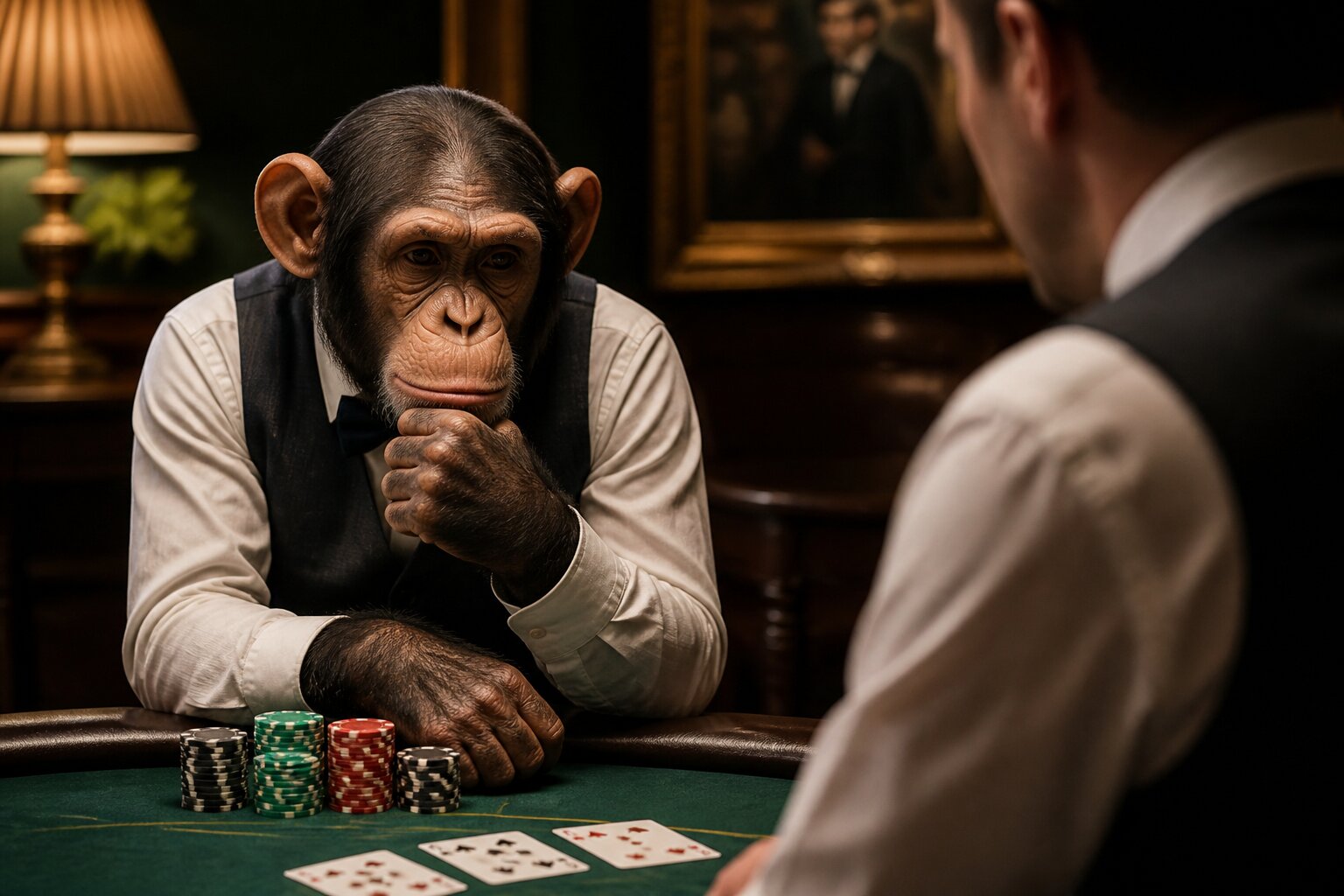
Ever heard someone shout “Monkey!” at the blackjack table and wondered what on earth they meant? Casino slang is full of quirky phrases, and “monkey” has sparked plenty of theories and misunderstandings over the years.
From stories told beside the felt to the shorthand players use during tense rounds, these expressions form part of the game’s social side. Curious about where “monkey” comes from, what it actually means, and how players use it? Let’s dive in.
What Does ‘Monkey’ Mean in Casino Slang?
‘Monkey’ is a casual term for a face card—any king, queen or jack in the deck. In blackjack those face cards all carry a value of 10, which is why the word crops up at the table: they are often exactly the cards a player needs to complete a strong hand.
You’ll commonly hear players call out “monkey!” when a face card would be favourable—for example, when a hand totalling 11 would benefit from a 10-value card. The shout is part encouragement, part table banter; it doesn’t change how cards are dealt or the rules of the game.
Face cards are referred to as such across many table games, but the term “monkey” is most often associated with blackjack. Next we’ll look at how that nickname travelled from some communities to become a broader piece of casino talk.
Origins of Monkey Slang at the Blackjack Table
The nickname likely travelled through international gambling circles, taking hold in Asian gaming communities before spreading more widely. English words that are easy to say and remember often get adopted in multilingual environments, and “monkey” seems to have been one of those terms that caught on.
There are a few possible reasons the word stuck. The animated illustrations on some older cards and a tendency for playful nicknames at the table would have helped. As global travel and tourism grew, so did the exchange of table customs, and the term moved with players between regions and casinos.
Today “monkey” appears in casinos from several different countries; it remains informal and light-hearted rather than technical or rule-based. Understanding that social history helps explain why the word still feels natural at busy tables and among regulars.
Myths Surrounding Monkey Betting
The energy of table games invites stories and superstitions, and “monkey” has accumulated a few myths over time. One mistaken belief is that calling for a “monkey” can influence the next card. There is no mechanism in play that lets a spoken word alter the shuffle or the card revealed.
Another frequent error is to treat “monkey” as applying to any 10-value card, including the numeric ten; however, the term is specifically used for the face cards only. Some new players also assume dealers have to react differently when slang is used, which is not the case—dealers may humour the chant, but they continue to manage the game by the rules.
These misconceptions are easy to spread in noisy rooms where phrases are used casually. Rather than relying on tales, it’s more useful to view “monkey” as table chatter with social value, not as a tactic or rule.
How Is Monkey Slang Used by Players and Dealers?
At the table, “monkey” is part of the shared language that raises the atmosphere and involves everyone in a moment of hope or humour. A player on 11 might call, “Come on, monkey!” when the dealer is about to draw, and others may laugh or join in. Dealers sometimes respond with a short, light remark, keeping the mood friendly while staying focused on the game.
This kind of exchange helps regulars find common ground and can make newcomers feel included, but it has no bearing on outcomes or payouts. The term’s role is social: it marks a moment of anticipation rather than changing the mechanics of play. If you enjoy table talk, it helps to learn other common phrases you might hear around the casino.
Other Popular Casino Slang Terms Explained
Knowing a few expressions makes table play more sociable and less bewildering. Below are several frequently heard terms and what they mean in plain language.
Blackjack (or “Natural”) – An ace plus a 10-value card as the first two dealt, totalling 21. Example: “I got a natural!”
Push – When a player’s hand ties with the dealer; the bet is returned. Example: “It’s a push.”
Bust – When a hand goes over 21 and is lost. Example: “I hit and busted on 23.”
Chip Down – Reducing the amount wagered for the next round. Example: “I’ll chip down to £5.”
High Roller – A player who regularly bets large amounts. Example: “That’s the high roller table.”
Cold Deck – A run of unfavourable cards for players. Example: “It’s been a cold deck tonight.”
Pit Boss – The supervisor who oversees table games and resolves disputes. Example: “The pit boss checked the table after a big hand.”
These phrases are part of the social toolkit at the casino. They clarify situations and help people communicate quickly during play, but they do not alter the rules or the dealing.
Why Do Some Slang Terms Cause Confusion?
Slang breeds confusion because it often assumes prior knowledge. Words like “monkey” don’t reveal their meaning at first glance, and regional variations or alternate non-gambling uses of the same word can add to the muddle. For example, a term that means one thing in a local context may mean something different at an international table.
Fast-paced gameplay also leaves little room to pause and ask for clarification, so myths can spread by repetition. That is why clear explanations and a calm willingness to ask questions are useful when new phrases appear. Playing within your means and knowing the game’s fundamentals will keep the focus on enjoyment rather than on chasing misleading ideas or taking on extra risk.
With a grasp of these terms and the social role they play, you should feel more comfortable listening in or joining the chatter at the table.
Enjoy Casino Games at Mega Reel
At Mega Reel, we welcome you to explore our site and discover the excitement our casino games can offer in a safe and welcoming environment. Whether you’re looking to relax or add a bit of entertainment to your day, we’re here for you.
**The information provided in this blog is intended for educational purposes and should not be construed as betting advice or a guarantee of success. Always gamble responsibly.