
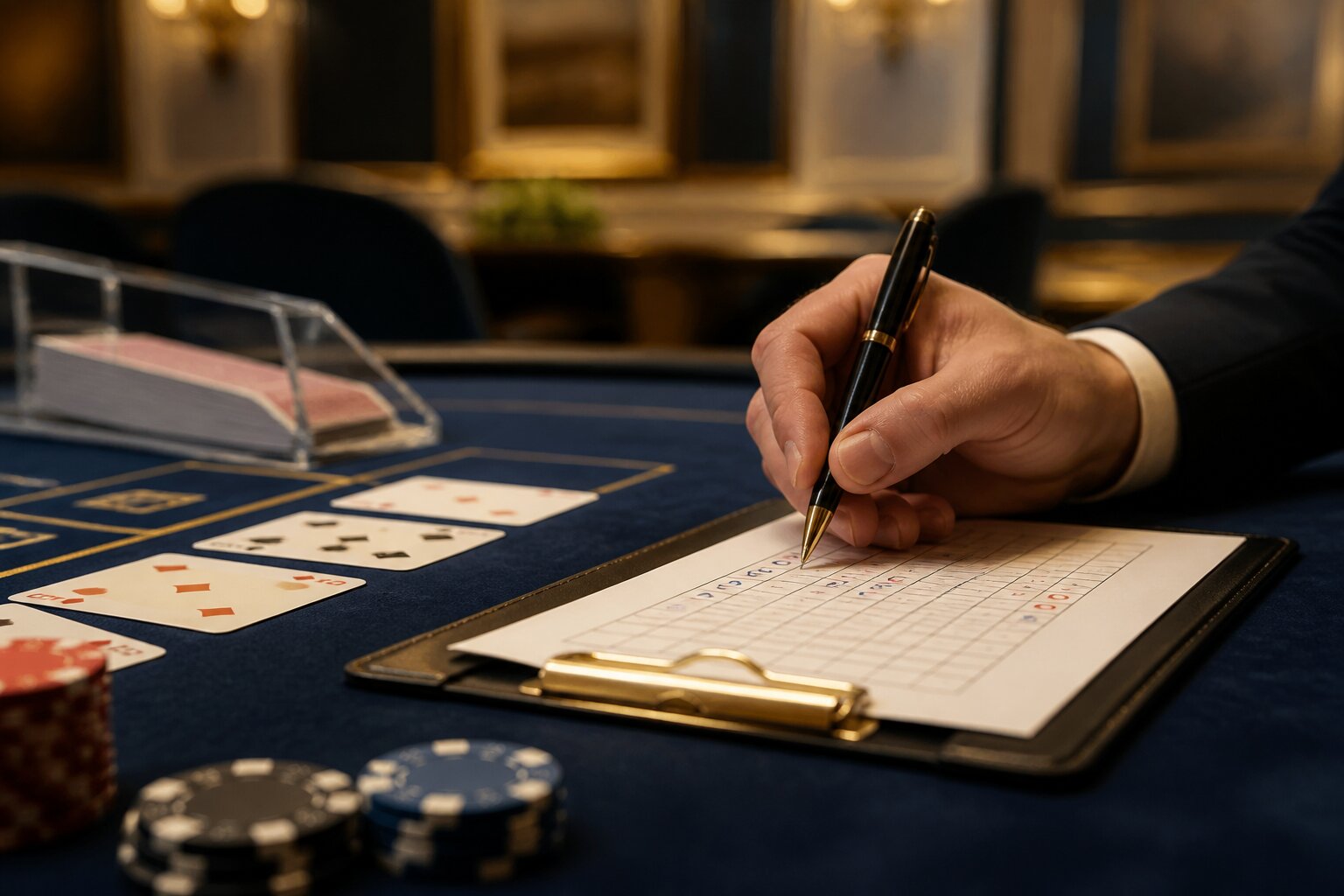
Ever wondered why so many players keep a close eye on the scores when playing baccarat? There’s a reason those scorecards and markers are never far from reach at the tables.
Tracking the flow of hands gives the game an extra layer of engagement. Whether you’re new to baccarat or have played before, learning how scorekeeping fits into a session helps you follow the action and makes each round feel more involved.
Curious how scorecards fit into all this? Read on to discover why tracking points and keeping records at the baccarat table matters—and how it could make your next session more engaging.
What Is Baccarat & How Does Scoring Work?
Baccarat is a classic card game you’ll find at many UK casinos, both online and in person. Its rules are straightforward and a few simple points determine each hand.
The main aim is to bet on which hand—Player or Banker—will have a score closest to nine; betting on a Tie is also an option. Each hand starts with two cards. Cards from two to nine are worth their face value, 10s and face cards count as zero, and Aces are worth one.
Scores are calculated by adding the card values and taking only the last digit if the total exceeds nine. For example, a 7 and an 8 add to 15, which counts as 5 in baccarat scoring. That scoring method is the foundation for everything players record on scorecards, so it’s helpful to be comfortable with it before you start marking results.
Why Is It Important to Track Points in Baccarat?
Many players track points simply to stay engaged. Writing down outcomes as rounds unfold creates a tangible record of the session and gives you something to follow beyond a single hand.
Keeping score also helps you remember how particular sequences played out, which can be useful if you like reviewing a session afterwards. For some, scorekeeping becomes part of the experience, a small ritual that adds structure and focus to an evening at the table.
It’s worth noting that scorekeeping is a personal preference: it changes how you interact with the game rather than how the game works. If it helps you enjoy the session more, it’s a reasonable addition to your play.
The Role of Scorecards in Baccarat
Scorecards are simple tools used to note the outcome of each deal. Typical cards show rows and columns where you can mark wins for the Player, Banker or a Tie, and some players use different marks to highlight streaks or alternations.
For many people, a scorecard makes the game feel more social: it’s a shared visual that everyone at the table can glance at to see how the session has progressed. It also serves as a quick reference so you don’t have to remember every single hand.
Although scorecards add interest, they don’t affect results. Their value lies in tracking and storytelling—helping you and others follow the session—rather than changing the underlying mechanics of the game.
If you enjoy the process of keeping records, scorecards can be both practical and enjoyable. If not, you can simply watch the table or use on-screen histories when playing online.
Do Scorecards Actually Help Players?
Scorecards can make the experience of playing baccarat more interactive, especially if you like observing sequences and comparing outcomes across rounds. They help you see how a session has unfolded in a compact, visible way.
That said, a scorecard does not change how each hand is decided. Every deal is independent; record-keeping does not alter the odds or predict future outcomes. Use a scorecard as a way to follow and enjoy the session, not as a method to gain an advantage.
If you want a simple way to start, a blank grid or the history feature in online games is enough to give you a clear visual of what has happened so far.
How to Use a Baccarat Scorecard
A basic approach works best: begin with a fresh card or on-screen grid and mark P for Player, B for Banker, and T for Tie each time a hand is resolved. Simple symbols—dots, slashes or circles—make the history easy to read at a glance.
Consistency is the key: mark every hand as it finishes so your record stays accurate. Many players add a small note when an unusual run occurs, but overall the system is meant to be quick and unobtrusive.
If you prefer visual patterns, some scorecards are designed with cells that show runs and breaks more clearly. Whichever format you choose, the point is to create a readable log of the session rather than an elaborate scheme.
Common Misconceptions About Scorecards
A frequent misconception is that scorecards can reveal a predictable sequence and therefore guide betting decisions. In fact, because outcomes are independent, a past run has no bearing on what will happen next.
Scorecards simply record what has already taken place; they don’t unveil a hidden rule or pattern that will influence future hands. Thinking otherwise can lead to overconfidence in perceived streaks, so it helps to keep scorekeeping in perspective as a record-keeping activity rather than a forecasting tool.
If you find yourself convincing others that a pattern will continue, it’s a good moment to step back and treat the scorecard as an archive of the session rather than a strategy guide.
Practical Tips for Tracking Scores Accurately
If you choose to keep a scorecard, keep the system straightforward. Clear, consistent marks are better than decorative but confusing symbols. Many players use P, B and T, or simple dots and dashes that they can read at a glance.
Record each round immediately after it ends to avoid mistakes. If you’re playing with others, agree on the notation so everyone reads the card the same way. For online play, the on-screen history often serves the same purpose and removes the need for manual notes.
Above all, tracking should not distract from managing your session. Keep an eye on time and budget, and pause if you need to reassess how you’re playing.
Should You Keep Score When Playing Baccarat Online?
Keeping score online is optional and often easier thanks to built-in history panels that show recent results. These features give you the same visual record as a physical scorecard without the need for pens and paper.
Online baccarat uses random number generators or live-dealer systems to ensure each game is fair and independent. These systems are independently checked by regulators and auditors to confirm they produce valid, unbiased results.
If you enjoy having a personal record, either use the game’s history feature or keep your own notes. If not, rely on the in-game display and focus on the aspects of play you find most enjoyable.
Conclusion: The Value of Tracking Points & Scorecards in Baccarat
Keeping score in baccarat is mainly about engagement: it gives players a way to follow a session closely and to record how hands have unfolded. Scorecards add context and a small layer of ritual without changing the mechanics of the game.
Use them if they improve your experience, but treat them as a personal record rather than a tool for prediction. Always manage your play sensibly by setting limits that suit you and taking breaks when needed. Scorekeeping is a choice that can enhance your enjoyment—nothing more, nothing less.
**The information provided in this blog is intended for educational purposes and should not be construed as betting advice or a guarantee of success. Always gamble responsibly.