
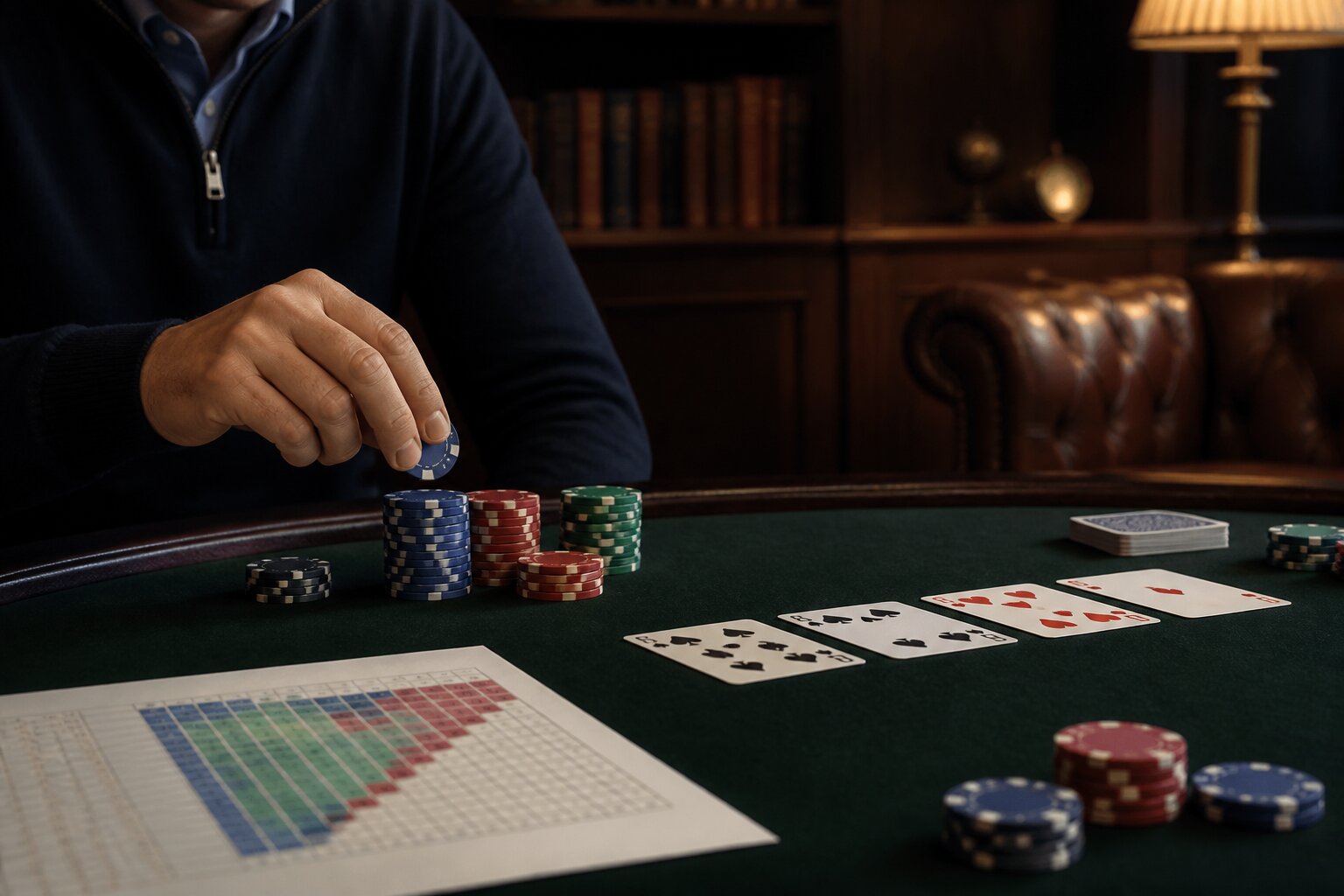
Ever wondered how top poker pros make decisions that seem almost unstoppable? It’s not just intuition—many of their choices come from Game Theory Optimisation, usually called GTO.
Whether you’re a beginner aiming to improve or a seasoned player keeping up with modern strategies, understanding GTO can change the way you approach the table. This guide explains what GTO is, why it matters, and how to use it to make smarter decisions.
Ready to see how the best structure their play? Let’s dive into GTO and the ideas that underpin elite decision-making.
What Is Game Theory Optimisation in Poker?
Game Theory Optimisation, often called GTO, is a way of choosing actions in poker that is rooted in mathematical balance rather than instinct. The concept aims to make your play difficult for opponents to exploit by mixing choices—betting, calling, folding, and raising—so patterns are less obvious.
GTO focuses on making choices that are robust over many hands rather than trying to outplay an opponent hand by hand. It does not promise a win every time; instead it reduces the chances that skilled opponents can profit from predictable habits. In practical terms, players using GTO work to keep their strategies consistent and defensible in the long run.
Think of GTO as one tool among many: it helps protect against exploitation and improves decision quality, but it sits alongside observational skills and table awareness. For clarity later on, when this guide refers to making play "balanced," it means using mixed lines so opponents cannot easily adjust to your tendencies.
Why Does GTO Matter for Poker Players?
GTO matters because it provides a stable framework for making difficult decisions. When you adopt balanced strategies, you limit the opportunities opponents have to exploit you. That stability can be especially valuable in games with experienced rivals who look for patterns to capitalise on.
Another advantage is psychological: when choices are based on sound reasoning rather than hesitation, you make fewer impulsive moves and maintain a clearer plan through swings in fortune. This steadiness helps in maintaining strategic discipline, even under pressure.
GTO also encourages better long-term thinking. Instead of responding only to immediate results, you evaluate how an approach performs across many situations, which improves decision-making overall.
If you plan to use GTO concepts, treat them as part of a broader approach that includes observing opponents and adjusting where appropriate. Keep your play responsible and within agreed limits.
How Does GTO Differ from Exploitative Poker?
GTO and exploitative poker represent different philosophies. GTO aims for balance so opponents cannot profitably deviate against you. Exploitative play, by contrast, is about identifying and taking advantage of opponents’ mistakes.
Using exploitative tactics might involve increasing bluff frequency against overly cautious players or folding more often against frequent raisers. It can yield higher returns in games where opponents give clear, repeatable edges, but it also opens you to counter-exploitation if opponents notice and adapt.
Many successful players blend both approaches. They use GTO as a base to avoid glaring leaks, then shift toward exploitative actions when the table offers reliable reads. The key is judgement: recognising which approach suits the table, the stakes, and the opponents you face.
Common Misconceptions About GTO Poker
A common myth is that GTO guarantees consistent success. In truth, GTO reduces exploitability but does not remove variability from results. Outcomes still fluctuate, and good decisions sometimes lose in the short term.
Another misconception is that GTO is only for professionals. While advanced analysis can be technical, the core ideas are accessible. Players can start with basic balanced concepts and build toward greater complexity as they gain experience.
Some people assume GTO means ignoring opponents altogether. That is not practical; observing tendencies and adapting when clear patterns appear remains important. GTO serves as a backbone for strategy, not a replacement for tablecraft.
Finally, GTO is sometimes thought of as a set of rigid rules. In real play it needs adjustment: stack sizes, table dynamics and betting structures all influence the right balance between theoretical and practical choices.
Key Principles of GTO Poker
Balanced Play
Balanced play involves mixing actions so opponents cannot assign a single line to a given situation. For example, when faced with a river bet you might call with some medium-strength hands, fold weaker holdings, and sometimes raise or bluff with specific blockers. That variety prevents opponents from making simple, profitable plays against you.
Consistency
Consistency means favouring decisions that are sound across many hands. Rather than swinging wildly between styles, a consistent strategy reduces information leakage, helping you maintain leverage against skilled players who hunt for predictable behaviour.
Minimum Defence Frequency (MDF)
MDF is a guideline for how often you should continue with a hand when facing a bet. If you fold too frequently you become an easy target for bluffs; folding too seldom leaves you paying off against better hands. MDF provides a mathematical baseline for defending so your ranges remain credible.
Optimal Betting and Bluffing Ratios
A core GTO idea is balancing value bets and bluffs so opponents cannot profitably call or fold always. Betting sizes and frequencies are chosen so that each action contains a mix of strong hands and bluffs, keeping adversaries unsure about your exact holdings.
Position Awareness
Position shapes many GTO choices. Acting later provides informational advantage, allowing more precise sizing and range construction. Conversely, earlier positions require tighter ranges and more caution. GTO strategies account for how position affects the range of hands you can credibly play.
These principles work together: balanced lines must sit within consistent play, informed by MDF, correct ratios, and positional considerations. That interplay is what gives GTO its strength.
When Should You Apply GTO Concepts?
GTO is most useful in games where opponents are able and willing to adjust their play. In higher-stakes cash games and advanced tournament levels, where many players seek to avoid obvious leaks, a balanced approach helps you avoid being targeted.
In more recreational settings, purely theoretical lines may be less profitable. If opponents make clear, repeatable mistakes, leaning toward exploitative play can be more rewarding. The wise player recognises when to stabilise with GTO and when to tilt strategy toward extracting value from observable faults.
Adapting GTO across formats means considering stack depth, blind structure, and the typical tendencies of players present. Over time, blending GTO fundamentals with live reads gives you the most flexible and effective approach.
Tools and Resources for Learning GTO Poker
For players wanting to study GTO, there are several types of resources that help different learning styles.
- Written guides and community articles break down concepts in plain language and illustrate them with hand examples. These are useful starting points for understanding basic principles like MDF and balance.
- Training software and solvers let you explore equilibria and see how ranges interact under different bet sizes. Interacting with simulations helps internalise what balanced play looks like in practice.
- Video lessons and coach-led content show hand histories and decision reasoning, making it easier to follow how theoretical ideas translate to real tables.
When choosing tools, look for reputable sources and materials that emphasise responsible play and fair use. Quality instruction helps you develop a thoughtful approach rather than rote memorisation.
Can Beginners Use GTO Effectively?
Beginners can absolutely begin with GTO ideas, but progress tends to be gradual. Starting with simple concepts such as the importance of:
- range composition,
- basic defence frequencies,
- how position changes choices
gives a practical foundation that is easier to digest and apply.
Applying these basics in low-stakes environments allows newcomers to test ideas without significant cost. Use small-stakes games, free practice tables or training software to try out concepts and see the outcomes. Tracking simple metrics, like win rate by position or frequency of continuation bets, helps spot where to focus study.
As familiarity grows, players can explore more detailed analyses and use training tools to refine their understanding. Working through hand histories, running solver drills and discussing spots with peers or coaches speeds learning, but avoid trying to absorb everything at once.
Patience is important. Mastery of GTO, like other poker skills, comes through repeated exposure and thoughtful study. Keep sessions within agreed limits, manage your bankroll responsibly and focus on learning rather than immediate results. If you find play affecting your wellbeing or finances, step back and seek support.
The Future of GTO Poker
GTO will continue to influence poker as analysis tools and training platforms advance. With more players studying equilibrium concepts, baseline standards of play tend to rise, making balanced strategies increasingly valuable at competitive levels.
Technology will also shape how players learn and apply GTO. Improved solvers, hand-tracking and AI-driven analysis help players evaluate ranges and find more efficient lines, while still leaving room for human judgement and adaptation.
Ultimately, successful poker remains a mix of sound theory, observational skill and disciplined bankroll management. As strategy evolves, the strongest players will be those who combine GTO foundations with sharp table awareness and careful self-control.
**The information provided in this blog is intended for educational purposes and should not be construed as betting advice or a guarantee of success. Always gamble responsibly.